


Most of the agricultural areas in Tunisia are intended for cereals crops and arboriculture. Crop rotation is not well diversified; it is practically limited to legumes. Through the 4CE-MED project funded by the European Union, INRAT, being the only Tunisian partner, is working to develop new innovative, diversified, and resilient Mediterranean agricultural systems. In this context, Camelina sativa will be introduced, as a new oilseed crop, in crop rotations, especially in marginal areas under a context of sustainable agriculture.
INRAT created a multi-stakeholder platform (Photo 1) to present this new crop which was almost or completely unknown in Tunisia and to develop a collaboration network between different stakeholders. Most of them expressed their interest in camelina, especially since it will contribute to the diversification of rotations, it is a low inputs crop, and it competes very well with weeds. At the same time, farmers, stakeholders, and researchers were interested to have more details about the technical itineraries of this new crop, which was 100% unknown. In 2022, they become familiar with this new crop and more interested to grow camelina, especially farmers.

Photo1: Meeting with farmers, stakeholders, and researchers
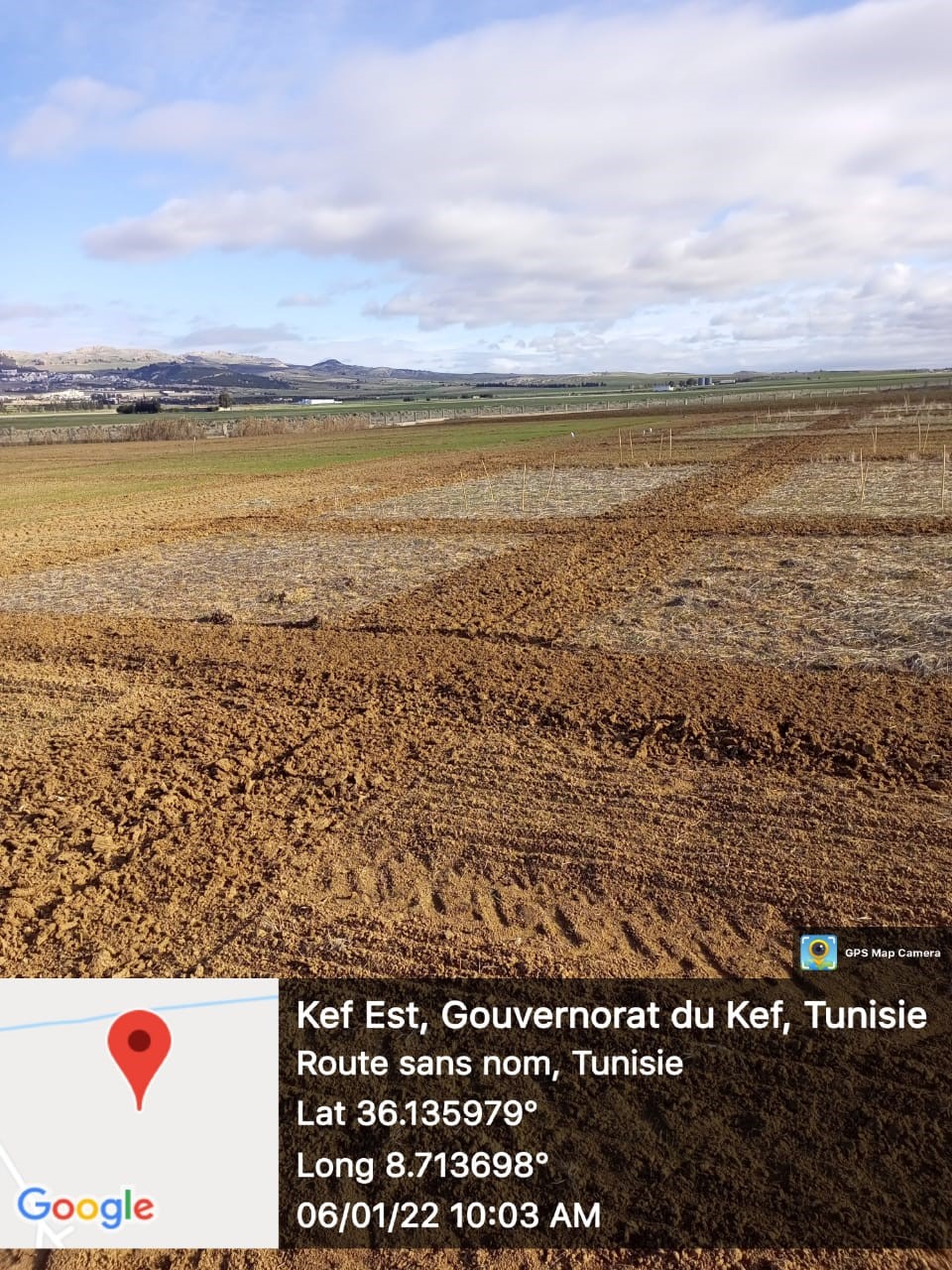
Since the begging of the project in 2020, various experiments were set up at INRAT experimental station in Kef, to better understand the requirements of camelina cultivation in real local conditions. Kef is in the northwest of Tunisia and is usually characterized by an unstable climate, ranging from very hot summers to cold winters. Optimization of the choice of camelina variety, the date and density of sowing as well as the best harvesting strategy were the main factors followed during this the cropping seasons (Photo2). The trials were mostly installed in December and harvested at the beginning of May.

Photo 2: Trials conducted in the experimental station of INRAT in El Kef
Each component of the technical itineraries was studied separately. The results of each trial were collected and analyzed to have the best combination to cultivate camelina. The results showed some differences between camelina varieties but, in general, most of the varieties were well adapted to local conditions.
A visit to the experimental station of Kef was organized by INRAT in March to present the camelina crop, especially that, as advanced, is a new crop in Tunisia (Photo3)

Photo 3: Field demo day organized by INRAT in March 2022
Moreover, a trial in farmer fields was also conducted this year 2022-2023 under real operational conditions and using farmer machinery. The crop has already emerged, and the trial is ongoing in the Krib region. The results of the project were presented to some farmers, stakeholders, and researchers and will be disseminated on a larger scale.