


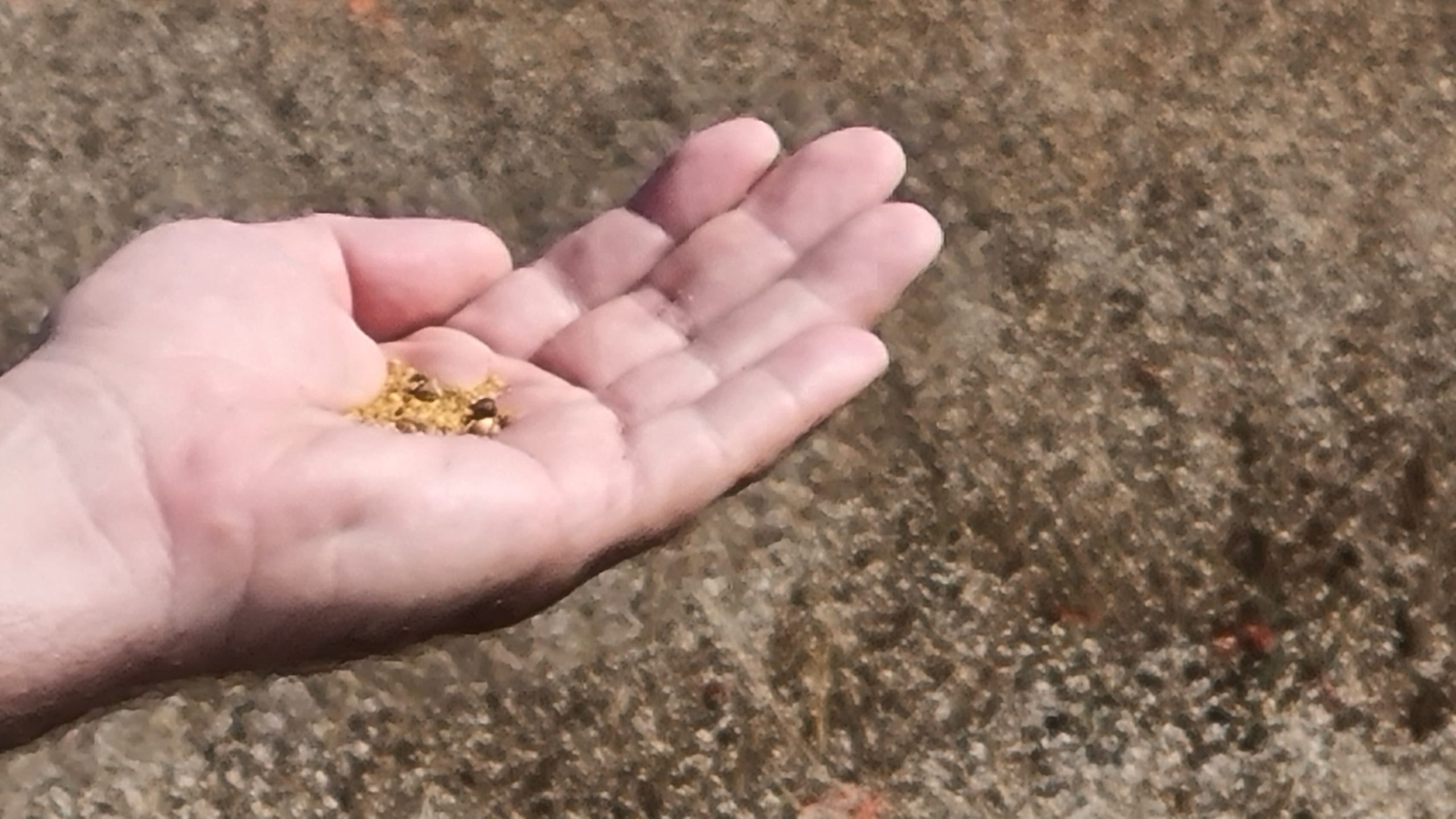
On 21 June, Cooperativas Agro-alimentarias de España (Spanish Co-ops) and Camelina Company (CCE), partners of the 4CE-MED and CARINA projects, organised a field visit for members of the Alcamancha cooperative to learn about the camelina crop.
With the aim of disseminating the need and benefits of adopting more sustainable practices in soil management and providing alternative crops with which to diversify the activity of their farms, Alcamancha has been collaborating with the 4CE-MED project since 2020 through Cooperativas Agro-alimentarias de España (Spanish Co-ops). Thanks to this collaboration, fifteen members of the cooperative were able to participate in this day to learn first-hand about the cultivation of camelina and the adjustments in machinery necessary for its harvest, carried out by another member of the cooperative itself under the supervision of the technical services of Camelina Company (CCE).
Taking advantage of the recent involvement of Cooperativas Agro-alimentarias de España (Spanish Co-ops), Cooperativas Agro-alimentarias de Castilla-La Mancha (CACLM) and Camelina Company (CCE) in the CARINA project, the synergies with 4CE-MED were used to present the objectives and challenges of both projects to the partners. The CARINA project aims to explore the possibilities of two oil crops, camelina and Brassica carinata, to obtain new bio-products that can be returned to the same farms where they are generated, thus achieving complete circularity while avoiding competition for land use with food. Examples of this would be the production of biopesticides, bioplastics or biostimulants, among others. The aim is to maintain close cooperation between the two projects at least until the end of 4CE-MED in the early summer of 2024.
Camelina Company (CCE) provided guidelines for optimised agronomic management of camelina, explained the necessary machinery adjustments for both sowing and harvesting, and presented the results of the trials carried out within the 4CE-MED framework with regard to management (tillage vs. direct sowing) and sowing (in-line vs. broadcast). The technical director also presented the business model developed in Spain in which the company accompanies the farmer throughout the cultivation process, from sowing to harvesting and subsequent management and marketing.
The new CAP has introduced in Spain a series of new features that are very much in line with 4CE-MED’s objectives. This is the case of the eco-scheme “Carbon farming and agro-ecology: Rotations and direct sowing in rainfed croplands”, whose characteristics, requirements and amounts of aid contemplated with regard to rotation practices with improving crops and direct sowing were presented by Cooperativas Agro-alimentarias de Castilla-La Mancha (CACLM). Both camelina and Brassica carinata are improvement crops that can benefit from this eco-scheme.
Likewise, the Spanish Association for Conservation Agriculture Living Soils, AEAC.SV, reviewed the benefits that the application of Conservation Agriculture practices such as direct sowing entail in terms of moisture retention, increased biodiversity, savings in inputs, etc.
The collaboration of the Alcamancha cooperative within the framework of 4CE-MED is a continuation of previous experiences with camelina and the optimisation of its use in semi-arid marginal areas in rotations, replacing fallow land. Alcamancha, in its desire to diversify the production of its partners, already has more than 200 hectares of lavandin and its own distillery to obtain the resulting oil, mainly for the cosmetics industry.
For their part, the cooperative’s members see camelina as an attractive crop to replace fallow land in marginal areas with low productivity, thus improving both the structure and their profitability by obtaining an extra income from it. Regarding the lack of adoption of no-tillage among cooperative members, they identified two main causes. On the one hand, the poor results associated with direct sowing of sunflower (a very widespread crop in the area) and, on the other, the high investment required by the machinery. The AEAC.SV explained that they are working within the framework of the GIRASOIL Operational Group to try to provide innovative solutions to the nascence problem that sunflowers present when using this cultivation technique.
An information day is planned for the beginning of October at which the results obtained by AEAC.SV in the report entitled “Introduction of camelina in arid soils in Conservation Agriculture” will be presented to the partners, as well as information on the trials carried out by Camelina Company within the framework of 4CE-MED and the new ways.
https://youtu.be/sqtjv5a9Vug?list=PL8y6SSLIEATHQtdyx0knzeQTTHX0uUxor