


Bios Agrosystems MABEE, in the frame of the 4CE-MED project, carried out field experiments of Camelina in the regions of Chalkidiki and Xathi, during the growing season 2021-2022, aiming at the most suitable seeding periods for two varieties of Camelina, Alba, and Luna.
In Chalkidiki, the Alba variety was sown as a winter crop on three different dates: 6/12/2022, 24/12/2022, and 20/1/2022). The harvest took place in the middle of June, but it could be happened much earlier, at the end of May. The yield range was 680 – 900 kg per hectare. The best yields per hectare were recorded on the first two seeding dates. The oil analysis of the Alba variety indicated that the fat content was about 44 g/100 g product, while the protein content was about 20 %. Camelina oil was extracted from seeds using the Acid Hydrolysis – Soxhlet method and Alba’s oil composition was rich in Oleic (14,59-15,73%), Linoleic (18,71-20,84%), α-Linoleic (31,30-35,14%) and Eicosenoic (14,41-14,54%) acid. The rate of fatty acids percentage depended on the different sowing dates.
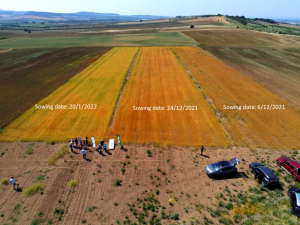
CAMELINA TRIAL IN CHALKIDIKI_Photo credit BIOS
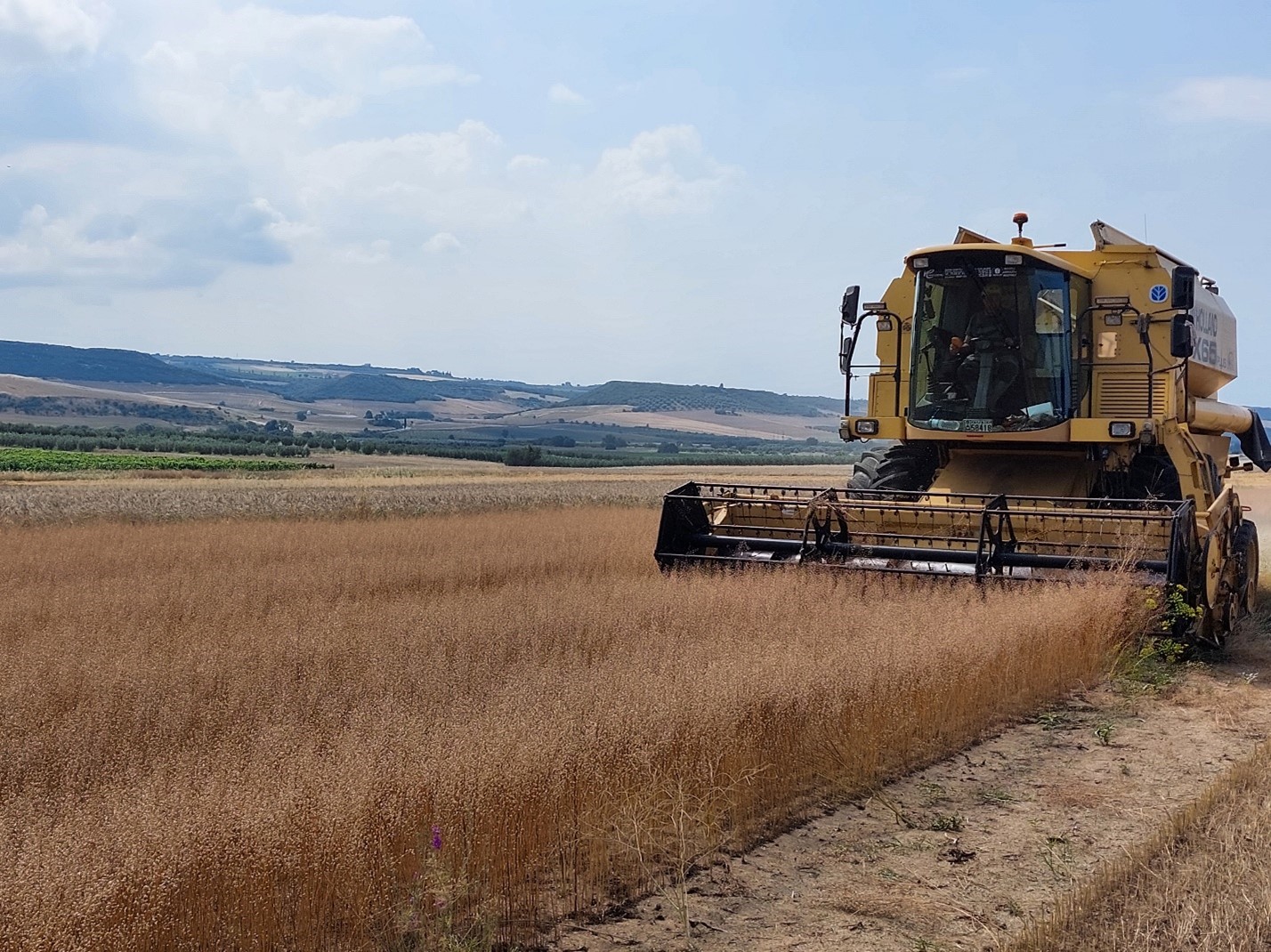
As regards the trial of Camelina in Xanthi, the Luna variety was sown as a summer crop and the seeding date was at the end of March (31/3) in 2022. In general, three irrigations were applied and the yield was about 1.600 kg per hectare. The growing cycle of the Camelina crop was very short (111 days), as the harvesting day was 19 July 2022. Luna variety had less fat content (33,7 g/100 g product) than Alba, but it had higher proteins contents 29,5 %. Luna’s oil composition was also rich in Oleic (12.60%), Linoleic (18.64%), α-Linoleic (35.50%), and Eicosenoic (13.13%) acids.

CAMELINA TRIAL IN XANTHI_Photo credit BIOS
The Camelina crop could be integrated into the rotation system of Greece as a cover crop since Camelina’s trials indicated many special agronomic characteristics, such as the short growing cycle, the possibility of double cropping, good soil cover, and low inputs. The most potential 4CE-MED farming system in Greece is through Camelina, by replacing a winter crop, and to enable double cropping with sunflower, and continue the next growing season with a winter cereal crop. The spring sowing of Camelina cannot compete with the others summer crops, i.e. corn, cotton, and sunflowers, regarding the yield and price potential. On the other hand, the 4CE-MED project aims to include Camelina in a farming system taking advantage of marginal lands and not competing with food crops’ land usage. Therefore, Camelina as a winter crop is the best solution in Greece. Bios Agrosystems is organizing the Camelina trials in cooperation with CRES for the current growing season 2022-2023, and the recommended farming system is presented below.