


Growing camelina into double cropping system in France raises questions about the regulations, particularly regarding the status of this crop with respect to changes in land use, despite numerous agronomic interests of this crop.
Indeed, sown in autumn and harvested in late May/early June before a primary food/feed crop or sown in late June after a primary winter crop, camelina can be considered as a cash cover crop and reach the sustainability criteria for energy uses. On the other hand, camelina is considered as a primary crop when it is sown on spring after a winter energy cover crop, a cropping system that is currently being developed with many agronomic and economic advantages.
The growing cycle of this crop must be clarified and regionalised to confirm the potential of these different production ways which will condition market price of camelina (higher for cover crop status due to sustainability criteria and renewable energy goals).
To this end, on the basis of a bibliographic analysis and the 4CE-MED trials’ first observations, an agroclimatic atlas was carried out to map and regionalise growing cycle for different sowing dates. These maps are also available for rainfall availability.
Taking into account the sum of average temperature without any other stress (water or frost), sowing Camelina on 15/10 would allow harvesting dates to be reached in mid-May in the south-western France and around the Mediterranean Sea (at least one year out of two). This harvesting date would be later for a sowing date at the beginning of November but this has to be confirmed. Indeed, small differences of harvest date have been noticed by UNIBO for this difference of sowing date.
For Centre and Western France, this harvest date would be delayed about 15 days for a sowing period in mid-October. North-eastern France conditions would not allow harvest before mid-june. Using these first results, new trial is underway on two-pass harvesting with pre-harvesting to accelerate the desiccation of the seeds and the establishment of the following crop. This mowing stage and the temperature requirements need to be specified.
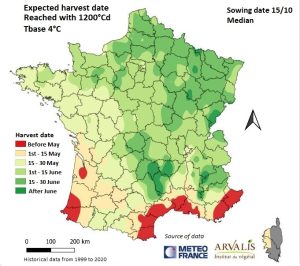
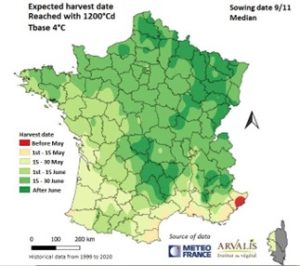
Figures 1 and 2: Agroclimatic maps obtained when Camelina is sown on 15/10 and 9/11