


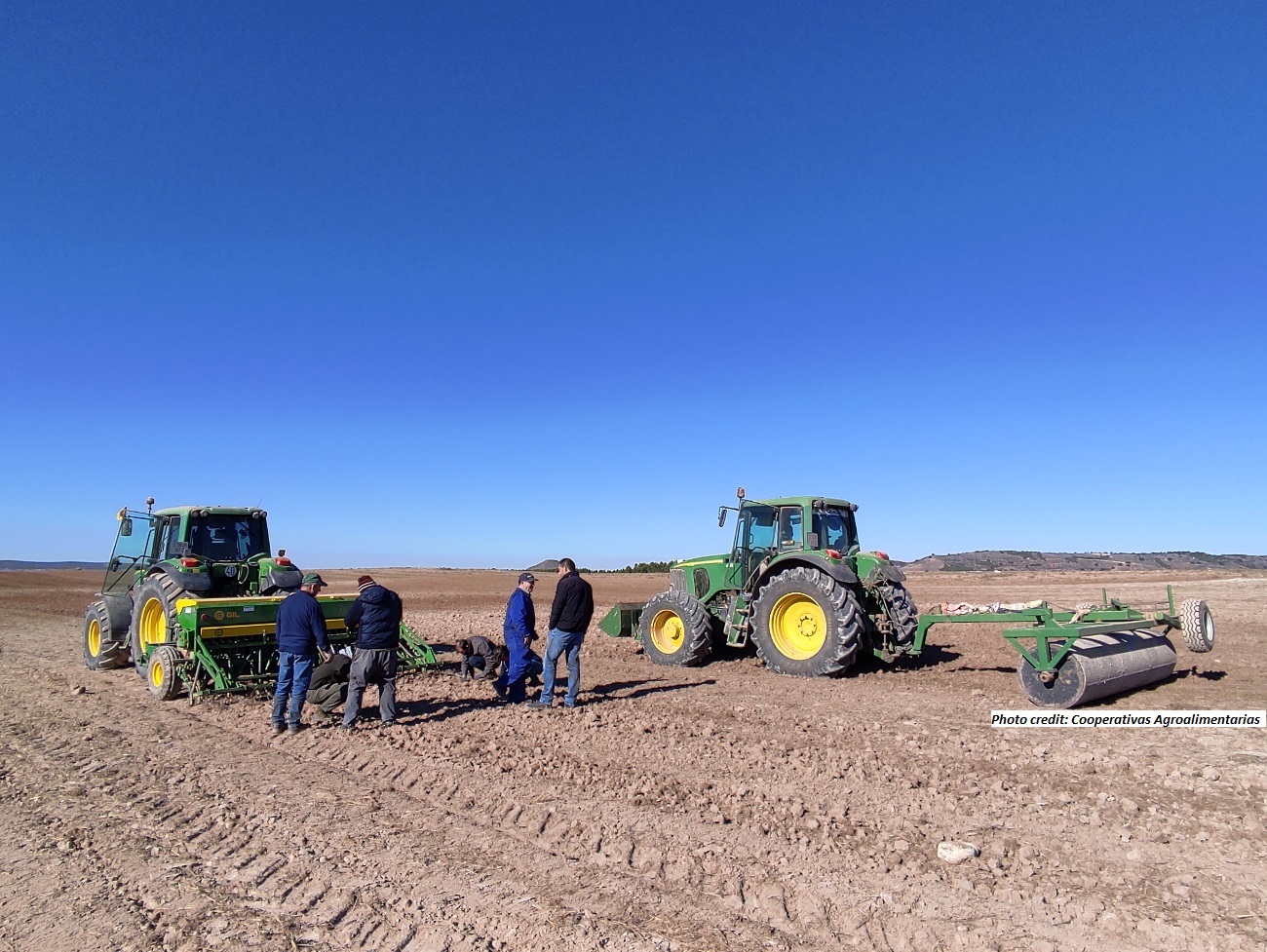
On Tuesday 16th November, camelina was planted in two plots belonging to members of the Cereales Alcamancha cooperative, both located in Valparaíso de Abajo (Cuenca). Alcamancha is a second-degree cooperative located on the border between La Alcarria and Mancha Alta that collaborates with the 4CE-MED Project in order to inform its members about the agronomic management of camelina cultivation and the advantages of implementing conservation agriculture, thus providing them with profitable alternatives for their rotations adapted to the semi-arid conditions typical of the area. The cooperative has previous experience in camelina cultivation, which will make it possible to compare the results obtained in the coming seasons.
Photo credit: Cooperativas Agro-alimentarias de España
However, camelina is not the only alternative crop introduced by the cooperative in the area. For some years now, it has been promoting the introduction of lavandin on its members’ plots, which it supports not only through technical advice but also through the creation of a distillery where the oil to be marketed can be extracted directly.
In relation to the 4CE-MED project, apart from the sowing of camelina on their own farms, training sessions are planned with field visits to sowings and harvests, dissemination days, participation in the national panel where they can share impressions and experiences with other professionals in the sector, etc. To this end, it will have the support of Camelina Company España (CCE), a company with extensive experience in camelina cultivation in Spain and other countries, the Spanish Association of Conservation Agriculture and Living Soils (AEAC.SV), which will advise on the best practices to be carried out for the benefit of the soil, and Cooperativas Agro-alimentarias de España (Spanish Co-ops), which will carry out technical monitoring and coordinate the actions implemented by the cooperative.
In the first campaign carried out within the framework of the 4CE-MED Project (2021-2022), 12 hectares have been sown in two plots next to each other with a surface area of 7 and 5 hectares, where barley was previously harvested. Staff from CCE, AEAC.SV, Alcamancha and Spanish Co-ops were present at the first sowing.
Photo credit: Cooperativas Agro-alimentarias de España
Due to the existing characteristics of the soil, it was rolled before sowing in order to homogenise it and allow the seed to settle better. A conventional seed drill was used for sowing, with a change of reel due to the small size of the camelina seed, the sowing rate was adjusted by modifying the variator and the depth was regulated so that the seed remained practically on the surface, covered only by a thin layer of soil removed by the harrow. The whole process was carried out under the guidance of CCE experts.
For its part, AEAC.SV collected data and took seed and soil samples in order to evaluate the behaviour of the soil and the camelina crop by conventional sowing compared to direct sowing carried out in other CCE plots and in the trials carried out within the framework of the project.
The first training activities will soon be carried out for the cooperative’s farmers, who will later visit the camelina plots in order to understand the characteristics of this crop in situ.
Photo credit: Cooperativas Agro-alimentarias de España