


Last first september the 4CE-MED Italian Stakeholder Platform included 17 members, (farmers, farmer advisors, regional policy makers and farmer associations). In particular, eight were women, and eight young people. The participants of the Platform represented different geographical areas of Italy, from the North to the South.
Main outcomes of the National Stakeholder Platform held in Italy:
- In Italy there are 900’000 ha of lands cultivated under CA practices. Each Italian region has defined different measures for developing CA under regional programs of agricultural development: the new CAP will focus on the need of developing new crop rotations while increasing the period of soil coverage.
- Apparently, it does not seem complicated to introduce camelina into conventional crop rotations based on cereals.
- The small seed size of camelina could cause problems with sowing in CA; selection for varieties having a higher seed size is desirable. Moreover, agronomic trials should be carried out on the dynamic of SOC in the new crop rotations including camelina.
- Camelina could be expected to play a significant role in containing soil erosion, particularly after the rosette stage.
- Despite simple and low cost agronomic management, camelina can reach significant seed yields (up to 2 Mg/ha under conventional systems); nevertheless, market potential and demand for its oil and cake is still uncertain mainly due to a poor knowledge of this crop in Italy;
- Farmers suggested to seed camelina in late summer-early autumn as “real cover crop” (single crop or in a mixture with other species) immediately after the main summer crop.
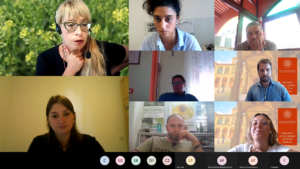
online meeting leaded by UNIBO